
Behind every social worker who’s ego is big enough to accept the invite to write a blog,- is without doubt a team of better social workers, brilliant admin colleagues and others making it possible.
I’ve worked with incredibly talented social workers over the years, who have inspired me to be better. From my first day as a social worker, when my line manager drew on a cigarette and very skillfully told me that wearing a hoodie for work wasn’t the done thing, through to working with a social work student last week, who was able to help me make sense of a family situation that had me perplexed, I have stood alongside brilliant practitioners.
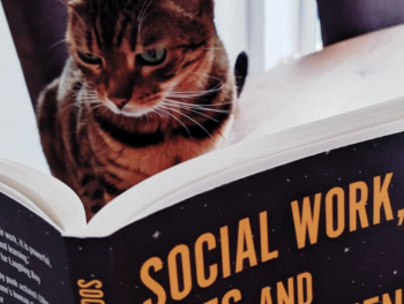
I have also had the privilege of supporting some amazing people as a social worker. The people I have worked with and their families and supporters have taught me so much. From working with people where I hopefully got social work right but also working with people where I know I didn’t – including Elsie and her cats, whose story is in our book Social Work Cats and Rocket Science, who unfortunately saw the worst of me as a social worker but hopefully was the catalyst I needed to try and improve.
Throughout my career I have worked alongside social work colleagues and witnessed the extent they go to supporting people to change lives, enhance lives, and in many cases save lives. That is an incredibly powerful and beautiful thing in its own right.
We know that because of issues like stigma and confidentiality and our own professional humility, we cannot always shout from the highest steeple about the work we do as social workers. Very often these are not our stories to tell, so we have to be selective about what we share.
But let’s not confuse our reluctance to be the loudest professional group, rightfully shying away from labels such as ‘angels’ or ‘superheroes’, to be mistaken into thinking that social workers are anything other than exceptionally skilled public servants – who work within an amazing professional value base, who deliver change, social justice and human rights to people who need social work support.
Sometimes only the people we support and social workers themselves truly know what social workers do – and that’s really ok.
So from one social worker to a group of social workers and leaders who knows the beautiful truth about what your social workers are doing, and why they do it and how fabulous it is that they do what they do – sincerely, thank you
Without wishing in anyway to be reductive, we tell our social work students and Newly Qualified Social Workers that first and foremost our aim as social workers is to help ensure people are healthy, happy and wherever possible, at home.
How we do that is where the more complicated bits come in, and sometimes that includes cats and even occasionally rocket science, and certainly academia, and theory and advanced practice.
About 3 years ago we were fortunate enough to work with a group of people with learning disabilities, who informed us as new managers to the Local Authority that they were sick and tired of hearing from the Council, from the psychiatrists, from social workers and from nurses.
To quote one guy, he had easy-read guides coming out of his ears about how great everything was going to be – but never was.
The people we met with wanted us to listen. So we did. This conversation with people with learning disabilities was a beautiful exercise in professional humility. Over a full summer and autumn people essentially told us 4 things that they think social workers need to know.
Firstly – people want a place called home, a real home, a home that looks like where we all live. A place that is safe and provides sanctuary and is a happy place and is not dependant on rotas, availability, or the disposition or mood of staff who work there.
A home that is the most relaxed place on earth, a place that is understanding, compassionate and where conversation and humour prevails.
A place where people have their own front door. A door that they choose to open and close to whoever they want and without question.
Secondly – work. People want jobs. And they want real jobs – not voluntary work. People paying social care charges to do voluntary work isn’t forward thinking – its modern day serfdom.
People told us that they don’t want false jobs that Councils create either. They don’t want jobs in cafes, where the only other people who work in the cafes are other people with learning disabilities, apart from the boss.
People told us that they wanted jobs that came with the certainty of a payday every week or every month.
And jobs that came with the certainty of employment, not because a project has got more funding from the Council, but because they are good at their jobs and worth keeping and people want to pay for their skills.
Thirdly – love. People want love. They told us that they wanted to experience love like everyone else did and not a sanitised version of it.
They want the rollercoaster. Over the top, down the dip – the highs, the lows and the mundane. The ecstasy of reciprocated love and the heartbreak of unrequited love.
They wanted to be loved and to feel themselves falling in love to the point where you can’t even eat your tea. That level of love.
But people were clear with us and pulled no punches. They wanted love but they also wanted sex, sexual relationships and the same sexual freedoms that all capacitous people experience.
This reminded me of Rosie, a young woman with learning disabilities who we worked with some years ago. Rosie had a great relationship with her social worker and the integrated Learning Disability Team and would often come to our team meetings to talk about her life, her loves and tell us where we need to be better.
One day Rosie told her social worker that she had met a guy at a bus stop one morning, fancied him rotten, got chatting to him, agreed to meet him at lunchtime, met with him, had lunch with him and went back to her house, where they had sex.
The social worker, clear that Rosie had capacity to make these decisions, happily added a note to that effect on Rosie’s record.
The case notes, overseen by her manager, were subsequently then forwarded on to Safeguarding colleagues, who in turn forwarded them on to colleagues in the Police, ‘just in case’ anything bad had happened to capacitous Rosie.
The guy at bus stop was arrested the very next day as he waited for his usual bus. His phone taken from him and he was interrogated by the police.
There were two safeguarding alerts raised in regards to Rosie, both wholly without her consent. One was sexual abuse. The other was financial abuse – Rosie had paid for both lunches.
The guy at the bus stop blocked Rosie’s calls and never took that bus again. Rosie never spoke to another social worker again, apart from to tell them that her story needed to be told.
We often say to social workers who hear that story for the first time – please be absolutely outraged at it. How wrong do we have to get adult safeguarding before safeguarding itself becomes abuse? Rosie wasn’t abused by the guy at the bus stop – she was abused by us.
And when it comes to love we need to be clear that as social workers we are not always starting from the best place.
I cannot recall any module at University on my social work course that went close to discussing love. I remember after I’d left University asking a social work lecturer why they had never talked about love and they said ‘well, we told you about Bowlby’!
Like Bowlby’s attachment theory was going to help us? Gazing into someone eyes and uttering the immortal words “Darling, I have something to tell you. I am deeply, madly attached to you” probably doesn’t cut it much.
But on day one as a social worker I realised it was all about love. All of it. Everything is about love or not love. Every unwise decision, every wise decision – love and moreover the possibility of love, of longing, or of desire – is what drives us. Yet for some reason this is rarely discussed during our education.
So understanding love must be on the curriculum and at the heart of our practice. As Paulo Fiere said through the pedagogy of the oppressed, “love is an act of courage, not of fear”. We must be courageous and ensure love and talking about love is central to all our social work.
When we talk about love in social work we aren’t saying social workers must love the people they support. That is not our role.
But what is our role is working tirelessly to ensure that everyone we support lives in an environment where to love someone and to be loved by someone, is a genuine opportunity.
I don’t believe any other profession in the Multi Disciplinary Team has that responsibility but I believe understanding love is the essence of social work.
So. Back to the list of things that people told us they wanted us to hear about their desires; a home, a job, love and fourthly, people told us that they needed hope and that sometimes as social workers we forget about hope.
For the people we spoke with, hope was about ambition, wanting more for themselves and more for their families. It was about a recognition that there is no hope in the day care, the home care, the residential home, the supported housing unit, the nursing home, the care programme approach and care management. These are not hopeful things. These are buildings or activities or warehouses or systems that are there to keep the body alive but very rarely the spirit.
Moreover, these things offered no meaning to anyone who accessed them. There was no advancement. No moving on. No progress. And really, no point.
As Victor Frankl said, “striving to find meaning in ones life is the primary motivational force in us all”.
The sad truth is that our Mary Poppins Bag of Social Care tricks – that provides home care, day care or residential care, dressed up as solutions – are not about hope. For too many people, social care that looks like that is ill conceived and badly timed and is actually about the person accepting the hopelessness of their situation. It opens up a social care world that is significant removed from the real world.
If we are to change things then we need to be brutally honest. Research, enquiries and reports into widescale abuse tell us what we need to know about social care, if we choose to see it.
Social care leads to a conveyor belt of more social care. Often poor quality social care. Which in turn inevitably leads to safeguarding issues, poor outcomes and tragically as we have seen all too often, resulting in health inequalities, reduced life expectancy and premature deaths.
How often as social workers have we placed people in care environments and talked to their relatives about the person needing time to ‘settle in’. And how often do we really mean that when we say ‘they need time to settle in’ what we really mean is ‘they need time to accept their situation, for their spirit to be broken, to be crushed by the realisation that going home to the things they love isn’t going to happen and that instead what awaits it is the beginning of the end, a long goodbye.
Whether we wanted to be confronted with the harsh realities of it or not, people didn’t hold back and told us that this is how social care feels too often. That it feels hopeless.
Perhaps even harsher than hearing that, is that people went on to tell us that hope is in the things that they think social workers have got. These things were friends, ambition, colleagues, families, jobs, promotions, pay, opportunities, holidays, cars, husbands, wives, children, grandchildren. People wanted Bigger, Better, Brighter.
Whether we think these things are hopeful or not – or just a manifestation of western capitalism that keep us all chained – we do so from a position of real privilege.
The things that social workers have got are hopeful things for those people who are not allowed the privilege of ever experiencing them.
If we listen to what people want, we can begin to understand how social work can position itself to deliver and to work in partnership and allyship to be complicit in delivering real change.
But to do that we have to be honest with ourselves. As a profession we have to acknowledge where social work has been taken by successive governments, where we are politically placed, where we are marginalised and where our social work voice has not been strong enough if we are to work to deliver change and ultimately ensure that social work delivers helpful, rights based support to people.
 Social Work, Cats and Rocket Science